How much turf to order: roll width, length, seams and waste
7 min read
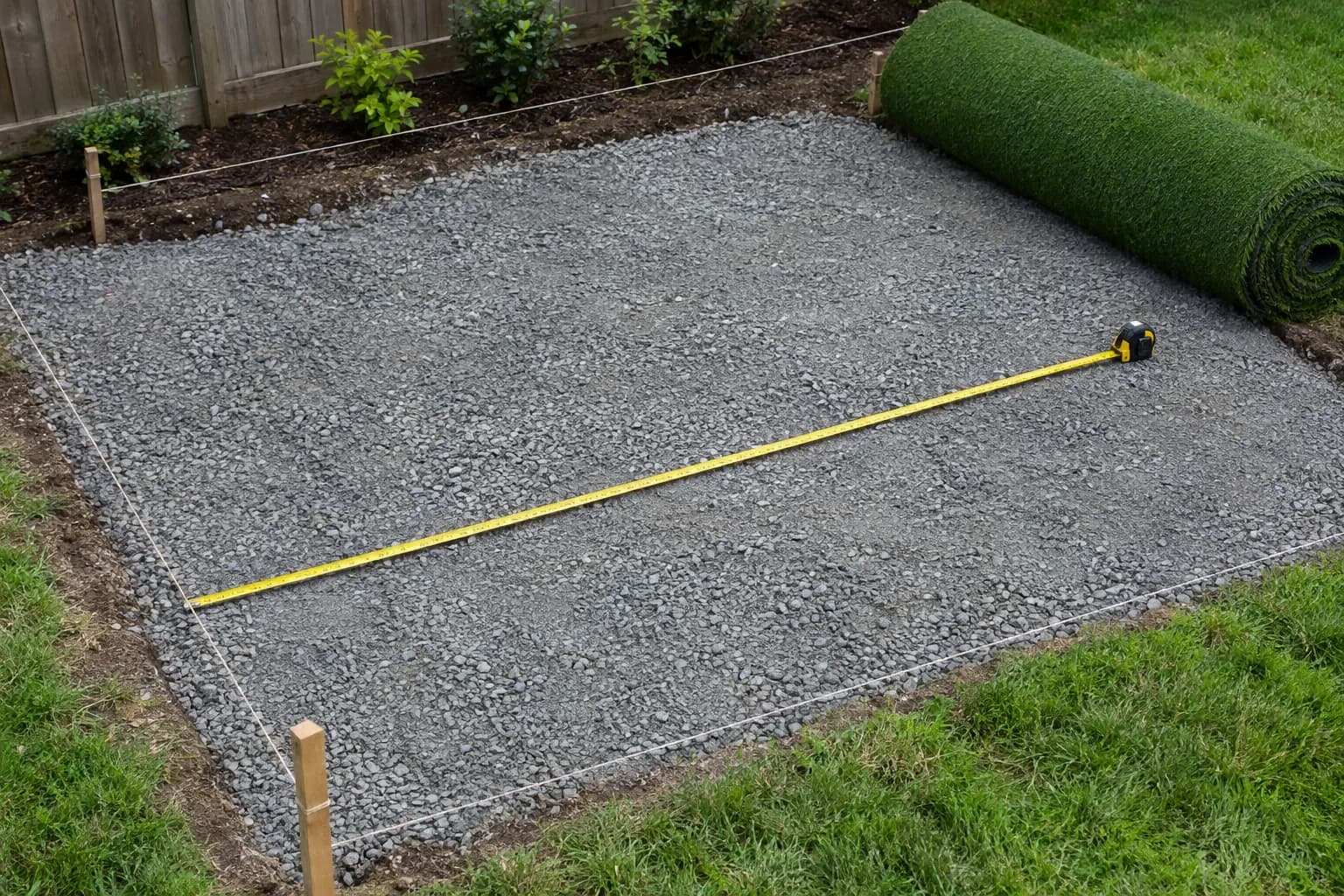
Our turf is sold the way it is made: on rolls 15 feet wide. You choose the length of each roll in whole feet, from 1 to 1,000 feet, and how many rolls you want at that length. The area you pay for is simple:
15 feet x length x number of rolls = square feet ordered.
The work is in choosing lengths that cover your yard with the fewest seams and the least waste. Here is how to do it.
Step 1: measure the area
Measure the longest and widest points of the space, not the average. Turf has to reach every edge, so a yard that is 24 feet wide at one end and 21 at the other is a 24 foot yard for ordering.
For a rectangle, two measurements do it. For an odd shape, sketch it on paper and break it into rectangles. Measure each one, then lay them out on your sketch the way the rolls would go.
Write down the measurements in feet and round up to the next whole foot.
Step 2: decide which way the rolls run
Every piece of turf has a grain: the blades lean slightly in one direction. All pieces in one area have to lean the same way, or the seams show as a change in color. That means you cannot turn a leftover piece sideways to fill a gap.
The grain usually points toward where people view the lawn from, such as the house or the patio. It looks fuller that way.
Within that rule, you choose whether the 15 foot width runs across the yard or along it. Try both. One direction often wastes far less.
Step 3: count the runs
One side of the area has to divide by 15. Divide that side by 15 and round up: that is the number of runs. The other side is the cut length, and each run is one roll at that length.
Take a yard 22 feet wide and 30 feet long.
| Rolls run | Width to cover | Runs needed | Length of each | Ordered | Yard | Trimmed off |
|---|---|---|---|---|---|---|
| Along the 30 ft side | 22 ft | 2 | 30 ft | 900 sq ft | 660 sq ft | 240 sq ft |
| Along the 22 ft side | 30 ft | 2 | 22 ft | 660 sq ft | 660 sq ft | 0 sq ft |
Same yard, two rolls either way, and one layout buys 36% more turf than the other. Always run the numbers both ways.
Step 4: round up, do not add a margin
Order the cut length as the side you measured, rounded up to the next whole foot. There is no extra margin to add: the measurement from step 1 already reaches the widest and longest points. In the example above, order two rolls at 22 feet.
That gives: 15 x 22 x 2 = 660 square feet.
On a curved bed, measure the run at its widest bulge, because the curve is cut out of a straight roll.
Step 5: plan the seams
A seam is where two runs meet side by side. With 15 foot rolls, any area wider than 15 feet has at least one. Seams join with seam tape underneath (the install kit includes it) and disappear well when the grain matches and the edges are trimmed cleanly.
A few layout habits help:
- Keep seams out of the main walking line where you can. A seam under a path takes more wear.
- Run seams away from the main viewing point, not across it. A seam seen end-on from the patio hides better than one running across your view.
- Avoid short end-to-end joins in a run. If an area is 40 feet long, order a 40 foot roll, not a 30 and a 10.
Step 6: work out the price
Multiply the square feet ordered by the price per square foot on the product page. As an example at a round $3.00 per square foot:
| Order | Square feet | Turf at $3.00 |
|---|---|---|
| 2 rolls at 22 ft | 660 | $1,980 |
| 1 roll at 40 ft | 600 | $1,800 |
| 3 rolls at 51 ft | 2,295 | $6,885 |
Delivery is a single charge per order: free to a commercial address and $200 to a residential one. Turf ships within 3 days of your order. The product page shows the area and the total as you type, so you can try layouts there before adding to your cart.
Odd shapes and leftovers
Leftovers can fill small areas if the grain still runs the same way. A strip trimmed off one run can cover a narrow side bed or the space between stepping stones, as long as you lay it facing the same direction.
L-shaped yards usually work best as two rectangles, each with its own run length. A circle or kidney shape is ordered as the rectangle that holds it.
Common mistakes
Ordering the area, not the rolls. A 500 square foot yard does not need 500 square feet of turf if it is 18 feet wide. It needs two runs, one of them mostly trimmed.
Forgetting the grain. Leftovers turned 90 degrees will look like a different color.
Measuring to the edge of the grass instead of the edge of the base. Turf covers the prepared base, which often runs to the hardscape or edging, a few inches past where the grass used to stop.
Splitting a run to save a few feet. The seam costs more in time and looks than the turf it saves.
Get a second opinion
If your yard has curves, levels or several sections, email us a sketch with the measurements. We will suggest a roll layout and send back the lengths to order. Before you place the order, read choosing turf by use if you have not picked a line yet, and the DIY install overview if you plan to lay it yourself.